


What do you need to consider when looking at the cost of fitted wardrobes? When you begin thinking about investing in fitted furniture, it’s tempting to shop by the bottom line. But the truth is not all wardrobes are created equal. The cost of a new bedroom can be affected by the finish, door style, internal layout and even the angles.
At Roy Newton Furniture, we believe transparency is key — so here’s a breakdown of what really drives cost and how you can make smart choices (without compromising on quality).
What Determines the Cost of Fitted Wardrobes?
1. Size & Quantity of Units / Furniture
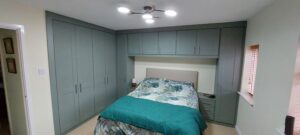
The more space you want to fill, the more material, labour and hardware you’ll need. A single wardrobe wall will cost far less than a full bedroom wrap-around.
Also, mixing in additional fitted furniture — e.g. dressing tables, overhead cupboards, wardrobes on multiple walls — multiplies cost. Always think in terms of “how much furniture” you’re asking for.
2. Door & Panel Style / Complexity (e.g. angled doors)
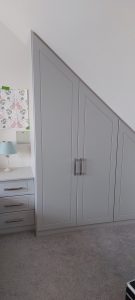
Straight, flat walls are the simplest and cheapest to work with. But many homes have:
sloping ceilings
alcoves
angled walls
skewed geometry
In other words, the more unusual the shape, the more work and precision it requires. That’s why angled doors cost more — they’re not standard sizes, so they need custom shaping, careful fitting, and often result in a bit more waste material.
3. Materials and Finish
This is where prices can diverge widely. Some key points:
Gloss, glass and mirrored finishes always cost more due to manufacturing processes, while matt finishes are generally more affordable.
Slab or flat panel doors (i.e. with minimal detail) tend to be cheaper than routered or shaped doors.
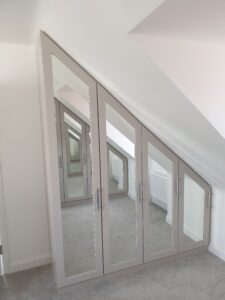
To see our range of simpler slab doors click here .
4. Internal Layout & Accessories
Your interior choices make a difference:
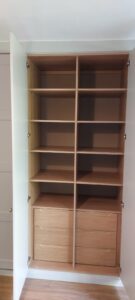
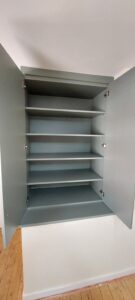
Shelves are generally cheaper than drawers (less hardware, simpler construction).
Pull-out racks, tie / belt rails, jewellery trays, pull-down rails, built-in drawers all come with extra parts, labour and precision.
Integrated lighting (LED strips, sensor lighting) also adds to the bill.
5. Hardware & Components
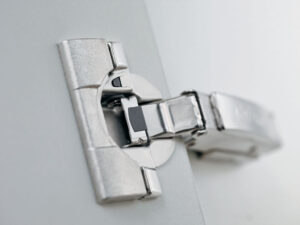
We don’t cut corners here. In fact, quality is at the heart of everything we do. That’s why we use Blum hinges and soft-close drawer runners as standard — because they guarantee smooth, lasting performance. You can read more about Blum hinges here.
Of course, using premium hardware can mean a slightly higher upfront cost — however, it also ensures your furniture continues to work seamlessly for years to come. In the long run, it’s an investment in reliability and everyday ease.
Budgeting Strategies: How to Control the Cost of Fitted Wardrobes (Without Looking Cheap)
If you have a limited budget there are smart ways to keep in control without ending up with poor quality. Here are some suggestions:
- Use shelves instead of drawers where possible (drawers cost more).
- Stick with matt finishes (less cost than gloss or glass).
- Choose slab / flat doors over framed or panelled designs.
- Limit the number of bespoke accessories; choose only the ones you’ll actually use.
- Reduce complexity — avoid many angled walls if possible, or adjust design so fewer angled units are needed.
- Phase the project: do critical wardrobe units first, add extras later (so your budget
isn’t all thrown into one stage).
Why It’s an Investment — Not a Cost
When you choose high-quality fitted furniture, what you’re really buying is long-term performance, aesthetics and value. At first, cut-rate materials may seem tempting — however, over time, warping, sagging, misaligned doors and poor hardware failings can all creep in.
At Roy Newton Furniture, our philosophy is built on craftsmanship, durability and care. That’s why we construct our cabinets using 18 mm MFC board, matching interiors and strong 8 mm backs. In addition, we partner with Hill’s Panel Products for precision components and install only reliable hardware. Together, these choices ensure your fitted wardrobe ages gracefully.
Ultimately, a well-made fitted wardrobe adds real value to your home — both in day-to-day living and long-term resale appeal.
Example Scenarios & Cost Comparisons
|
Scenario |
Simpler / Budget Approach |
Premium / Fully Featured Approach |
|---|---|---|
|
2-wall bedroom wardrobe (straight walls) |
Matt slab doors, mostly shelves, minimal drawers, basic handles |
Gloss or glass doors, integrated LED lighting, drawers + pull-outs, mirrored panels |
|
Loft or sloping ceiling area |
Keep the angled section small, use a simple finish |
Full angled doors, panelled design, premium finishes |
|
Partial project (e.g. one wall) |
Do essentials first, add extras later |
Full wrap-around fitted units with extras included from the start |
These contrasts are designed to help you see how your design choices affect price and how you might prioritise within your budget.
The cost of fitted wardrobes – final thoughts
Budgeting for a fitted wardrobe is about understanding the factors — not just chasing a low price. The finish, door style, internal layout, angles and hardware all play their part. Make choices wisely.
If you’re ready to invest in something that’s built to last, while still tailoring to your budget, we’re here to guide you. You don’t have to settle for cheap — you can aim for value.
Head over to our High Quality Fitted Furniture – Bespoke Designs Built to Last blog page to see why our approach favours excellence over shortcuts.

Get in touch with us today for a no-obligation quote or design chat.
Whether you’re ready to start your project or simply have a few questions, we’re here to help.
Contact us on 07969 124803 / 01543 897740. Or alternatively, click here to email us if you’d like a free quote or further information.
We look forward to hearing from you and assisting with your next home transformation!


